

Quantum Microwaves Communication and Sensing (QMiCS) is an EU Quantum Flagship project to develop QLAN, a quantum local area network between two dilution fridges. QMiCS is one of 20 projects funded in the first call of the European Quantum Technology Flagship Program.
Oxford is a key partner supporting the development of a quantum microwave local area network over a distance of several metres. This architecture will enable quantum communication protocols such as teleportation between two superconducting quantum nodes. This approach has future applications for distributed quantum computing and radar-style quantum sensing with microwaves.
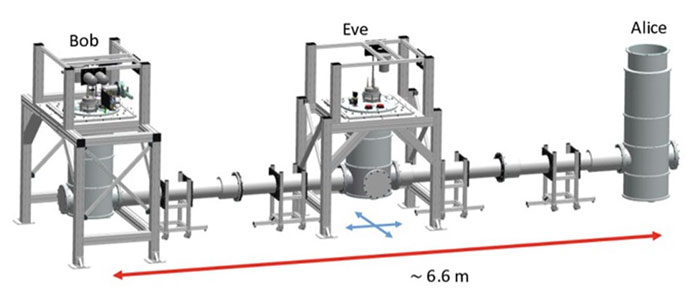
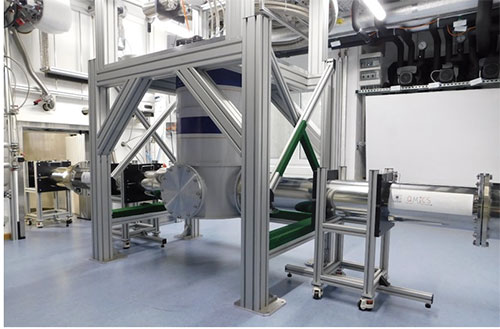
The main task of QMiCS is to explore the potential of non-classical propagating microwaves, whose behaviour is controlled by the laws of quantum mechanics, for future applications and commercial exploitation.
Oxford provided the cryogenic hardware for this project; a 6.6 m cryogenic link, with intermediate Cold Network Node (CNN), to connect two dilution refrigerators together at millikelvin temperatures. The CNN can provide future connections to other dilution refrigerators.
For more information on QMiCS, see the project website.
For additional information:
Get In Touch
The European Microkelvin Platform (EMP) is a consortium funded by Horizon 2020 and is made up of 17 different partners from academic institutions and industry.
The EMP provides a comprehensive portfolio of ultra-low temperature capabilities and expertise, allowing the users from across Europe, to study new phenomena in the mK and µK regimes, thereby generating new knowledge, applications and commercial opportunities. EMP have a particular interest in the benefits of ultra-low temperature physics for driving forward the inter-related areas of quantum materials, nanoscience, and quantum technology.
Oxford has been a key member of EMP, providing shared expert knowledge on cryogenic environments and platforms for new quantum technologies.
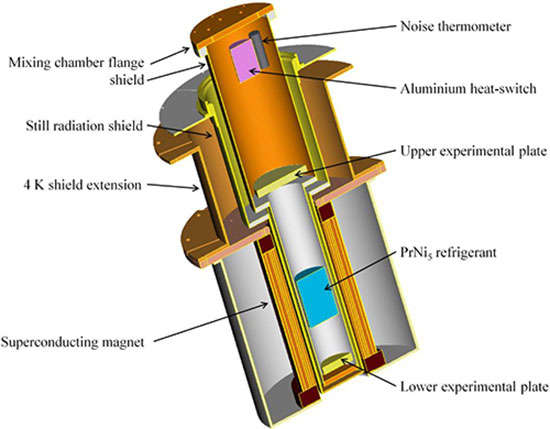
Our dilution refrigerators, cryostats and magnets can be found in labs across the member institutions including a top-loading dilution refrigerator and Triton200 dilution refrigerator at the Slovak Academy of Sciences in Kosice, Slovakia and three wet dilution refrigerators and a Triton200, all customised to be nuclear demagnetisation refrigerators to work in the sub 1 mK regime, at the London Low Temperature Laboratory, Royal Holloway University of London.
A proof of concept nuclear demagnetisation stage for a dry dilution refrigerator, a Triton200, was developed as a part of the European Microkelvin platform between Royal Holloway University of London and Oxford Instruments NanoScience. This forms the basis of a rapid prototyping system for experiments that require < 1 mK.
As part of this project, Oxford designed and provided the magnet, customised mixing chamber plate and customised mixing chamber shield.
For more information on the EMP, see the project website.
For information on this project, please see the publication on the proof of concept demagnetisation stage:

For additional information:
Get In TouchCopyright © 2025 Quantum Design Oxford