
Lisa Rooth
SCALINQ

Zaid Saeed
SCALINQ

Harriet van der Vliet
Interviewer
As part of our continued engagement and collaboration with companies within the quantum ecosystem, we were keen to ask a series of questions to find out more about how they view quantum and how they are looking to apply their solutions to different cryogenic systems.
Here we talk to SCALINQ about their latest developments and find out how these can be added to cryogenic platforms: including Oxford Instruments’ Proteox range of dilution refrigerators!
For our first quantum ecosystem company Q&A, I am joined by Zaid Saeed and Lisa Rooth from SCALINQ.
“Quantum Computing is transitioning from proof-of-concept towards commercial viability. The hardware aspect of quantum computing is certainly one of the major challenges that the community is trying to tackle these days. If we are to reach commercial viability, we need to build a much more optimized hardware infrastructure around the qubit chip itself, and this is exactly where SCALINQ is operating. We are developing high-density, cryogenic components to facilitate the efficient upscaling of superconducting quantum devices.
“Today, SCALINQ is offering universities, research institutes, and commercial players a highly adaptable sample holder (LINQER) to host their quantum devices regardless of the number of qubits or the size of the chip.
Our focus has been to create a high-performing solution—in terms of magnetic/IR shielding and high quality signal transmission—while keeping a low cost and high space efficiency. With our unique connectors that enable high-density wiring and a unique shielding setup, we are able to develop sample holders hosting between 8 and 300 RF lines, depending on the needs of our customers. Currently, we have four standard versions that facilitate 16, 36, 52 and 80 RF lines.
Adjustability is important in the current NISQ era. Different researchers are focusing on solving different problems, and one-size-fits-all solutions are currently not an option. That is why we have designed with flexibility in mind and can adjust our solutions based on customers’ needs while not compromising on our lead times.
“Yes, they are compatible. Large parts of quantum computers are yet to be standardized; however, dilution refrigerators have lately started to take a standardized design. SCALINQ has developed suitable mounting brackets to fit Oxford Instruments Proteox dilution refrigerators, among others. We also work closely with the industry to ensure that our designs are compatible with upcoming refrigerators and components.
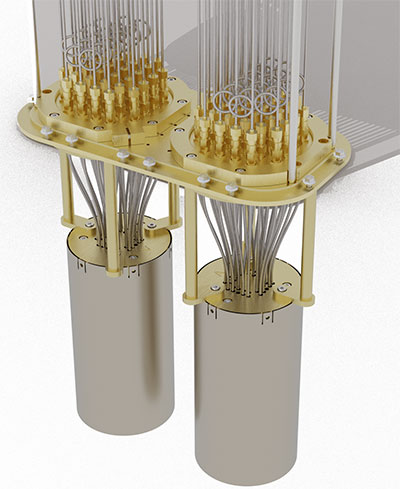
“At SCALINQ, we believe that collaborative R&D is crucial to realizing quantum computing. We need to stop developing behind closed doors as it only leads to actors reinventing the wheel. Instead, we want to engage in more collaborative projects to help create expert knowledge in different areas of quantum computing development. Working with companies like Oxford Instruments supports a transparent R&D process where we can share insights to move the technology forward.
We are also seeing a lot of new players entering this field, which is great! They, however, do not have years of development to rely on and are looking for validated and easy-to-implement solutions. Although we develop cutting-edge solutions, we also understand the importance of making plug-n-play (research) solutions to help these new teams and labs get a quick start through collaborative work, such as integrating our products with Oxford's.
“One of our co-founders, Sandoko Kosen, working with others at Chalmers University of Technology, co-authored a paper on flip-chip integrated superconducting quantum processors. Together with the Chalmers team, he is currently working on the next generation scaled-up multi-qubit processors that are hosted in our very own LINQER80.
“We are already well underway with the development of the next-generation sample holders that will further help researchers gain more control over the signal transmission from room temperature to the qubits. In addition, we are working on solutions to expand our portfolio with much-needed cryogenic hardware beyond sample holders.
To learn more about Oxford's collaboration with SCALINQ:
Visit our SCALINQ PageCopyright © 2025 Quantum Design Oxford